
Picking a textured wall finish is easy to get wrong, because all three popular options look good in a photo. The real question is how each one behaves after a few years of kids, furniture and daily life. This guide compares limewash vs Venetian plaster (plus fluted panelling, the third contender) on cost, durability and upkeep, so you can choose the finish you’ll still like in five years. If you’re planning a custom home or knock down rebuild in Glen Waverley, Kew, Balwyn or Doncaster, it’s best settled at design stage.
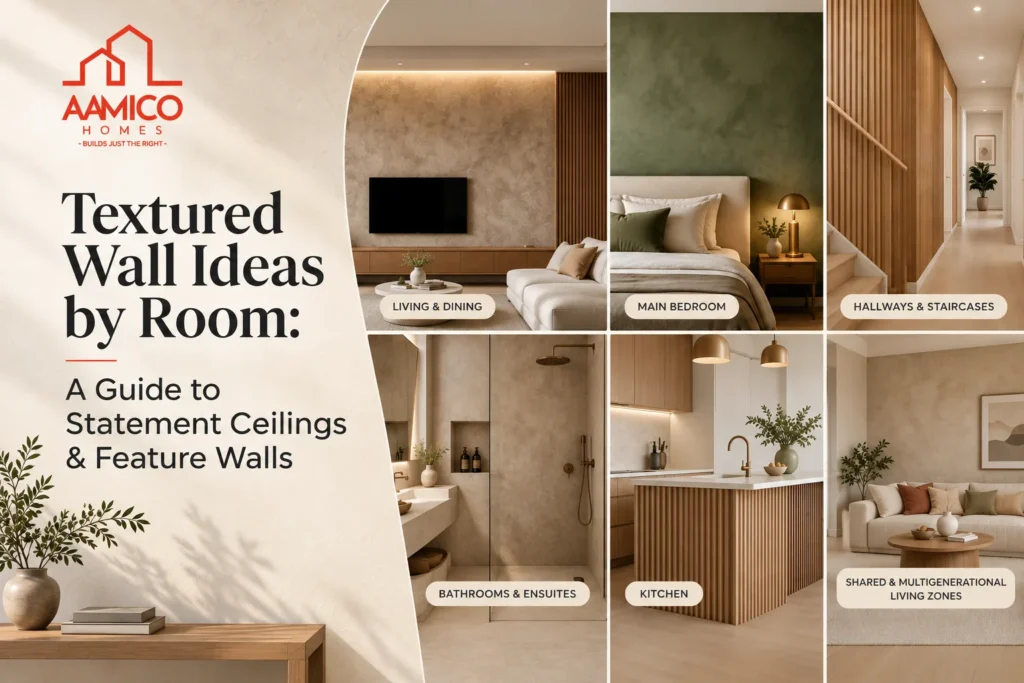
Limewash is a mineral, lime-based paint, brushed on in thin, overlapping coats. It gives a chalky, matte, slightly cloudy look and is highly breathable.
Venetian plaster is built from lime putty and fine marble dust, troweled on in several thin layers and then burnished. It can range from soft matte to a deep, polished sheen.
Fluted panelling is a different thing altogether. Rather than a surface finish, it adds vertical timber, MDF or composite battens that create texture through shadow and depth.
|
Limewash |
Venetian plaster |
Fluted panelling |
|
|
Look |
Soft, matte, cloudy |
Polished, stone-like depth |
Strong vertical lines and shadow |
|
Typical cost |
35–65/m² (Australia) |
160–250/m² (Melbourne) |
150–300/m² (Victoria, slat style) |
|
Durability |
Moderate; can mark |
High once cured and sealed |
Good on dry walls; dents and chips possible |
|
Upkeep |
Touch up or recoat |
Occasional wax or reseal |
Regular dusting of grooves |
|
Repairs |
Easy to blend |
Harder to match a polished finish |
Harder to patch than a flat wall |
|
Best for |
Bedrooms, feature walls |
Living areas, entries, fireplace walls |
TV walls, hallways, stair walls |
The biggest practical difference is repair. A scuff on limewash can usually be blended with a small touch-up, while a damaged polished plaster wall needs a skilled hand to match. Venetian plaster, being denser and burnished, is less likely to be damaged in the first place.
Take a feature wall of around 10–12 m². Working from the ranges above, limewash would come to roughly 350–780, slat or fluted panelling roughly 1,500–3,600, and Venetian plaster roughly 1,600–3,500 (the top figure reflects one Melbourne applicator’s own feature-wall example). These are rough illustrations, not quotes, and substrate preparation can add roughly 20–50/m² for plaster finishes.
Most wall-finish regret comes from mismatching the finish to how the room is used, not from the finish itself. A few checks help:
At Aamico, textured finishes are part of the design conversation, not a variation after contract. During the design stage of your knock down rebuild we help you weigh look, cost and upkeep for each room, and price the finish into your fixed site costs from the start.step-by-step building process shows where finish selections fit in your timeline, and for families building across generations we’ll help you choose finishes that suit everyone’s daily use.
When it comes to limewash vs Venetian plaster, the right choice depends less on trend and more on the room: limewash for calm, lower-cost spaces, Venetian plaster for polished, high-contact feature walls, and fluted panelling when you want structure and shadow instead of a plaster surface. Work out who uses each room and who will maintain it, and the decision usually becomes clear. See why families choose Aamico Homes or book a design consultation to choose the right finish for your floorplan
Limewash is a thin, brushed-on mineral paint with a matte, cloudy finish. Venetian plaster is a multi-layer lime and marble-dust plaster that is troweled and burnished for depth and sheen. Venetian plaster is generally denser, more scuff-resistant and more expensive
Generally, yes. Burnished Venetian plaster is harder and holds up better in busy areas, while limewash is easier to touch up or recoat when it marks. Both are long-lived when applied by an experienced applicator
Not as a waterproofing layer. Wet areas must be waterproofed under the NCC and AS 3740:2021, and any decorative finish sits over that system. Sealed Venetian plaster can cope with splashes in some applications, but inside a shower recess ask your builder about suitable specialist finishes such as tadelakt or microcement.
It needs more regular dusting because dust settles in the grooves, and solid timber or MDF versions can swell in humid rooms. It is also harder to patch than a flat wall. On dry walls, it is usually low-effort with a soft brush attachment.
Limewash is usually the cheapest of the three, at roughly $35 to $65 per square metre in Australia. Panelling and Venetian plaster cost several times more per square metre, with Venetian plaster driven mainly by skilled labour.

Copyright © 2023– Aamico Homes, All Rights Reserved | Website & Marketing By Bizuter