BLOG

How Much Do Different House Foundations Cost in Melbourne? Slab vs Stumps vs Piers

House foundations in Melbourne typically cost $95–$160 per square metre for a standard concrete slab, or $140–$550 per unit for stumps and screw piles, with the exact price set by your block’s AS 2870 soil classification.

  • Waffle pod slab: $95–$160 per m²
  • Raft slab: 15–25% more than an equivalent waffle pod slab
  • Stumps: $140–$550 per stump, supplied and installed, depending on material
  • Screw piles: $150–$300 per pile

For a typical 200m² home on a standard Class M site, that puts a waffle pod slab foundation at roughly $19,000–$32,000. A Class H site, a sloping block, or a design needing piers or stumps instead of a slab can push the total significantly higher, a soil test is the only way to know which range applies to a specific block.
If you’ve had a soil test come back and suddenly heard words like “Class H” or “waffle pod” in the same sentence as a much bigger number than you expected, you’re not alone. Foundation type is one of the biggest hidden swing factors in a Melbourne build cost, and on the reactive clay common across growth-corridor suburbs like Truganina, Melton and Mambourin, the difference between a straightforward slab and an engineered pier system can run into the tens of thousands. Here’s what slab, stump and pier foundations actually cost in 2026, and why.
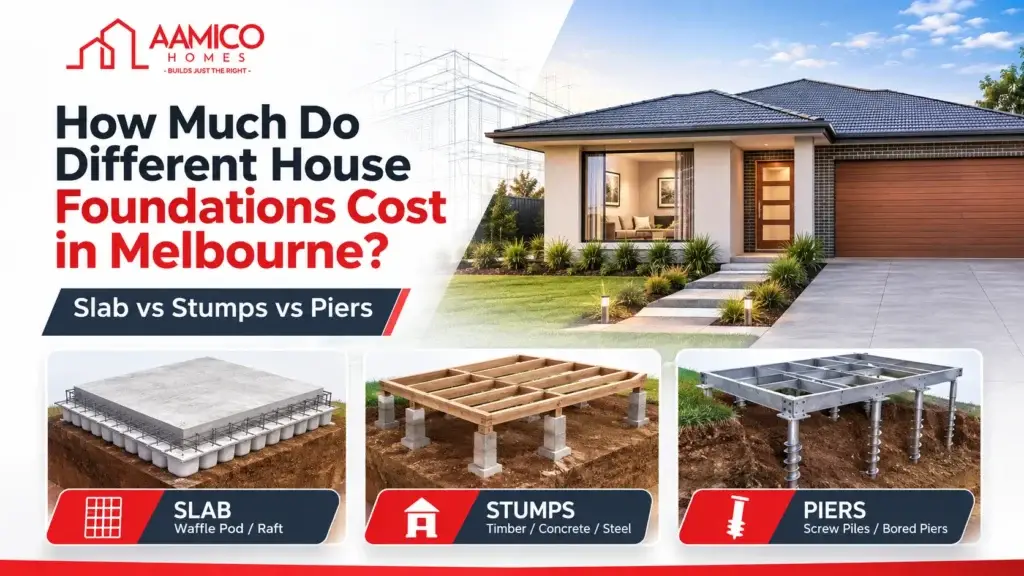
Infographic comparing house foundation costs in Melbourne, featuring slab, stumps, and piers with a modern home and AAMICO Homes branding.

Why House Foundations Cost So Much More in Melbourne

Foundation cost isn’t really about square metres, it’s about what’s underneath them. Melbourne sits on some of the most reactive clay in Australia, and under AS 2870 (the Australian Standard for residential slabs and footings), your block is assigned a site class from A (stable sand or rock) through S, M and H, up to E or P (extreme or problem sites) in rarer cases. The National Construction Code requires every new residential footing and slab design to be classified and constructed in accordance with AS 2870, so this isn’t an optional step, it’s the legal starting point for pricing any foundation. Victoria adopted the latest NCC 2025 edition from 1 May 2026, so this is the version currently governing new residential footing and slab design across Melbourne.

The higher the site class, the more concrete, reinforcement and engineering your foundation needs to resist the soil swelling and shrinking with the seasons. A Class M site (the most common classification across Melbourne’s metro and growth-corridor suburbs) is the baseline most cost guides quote from. A Class H site typically adds 15–35% on top of that baseline, and Class E or P sites can require engineered pier or screw pile solutions regardless of which foundation type you’d otherwise have chosen, the Building and Plumbing Commission’s own consumer guidance (the regulator formerly known as the Victorian Building Authority) confirms that an endorsed building engineer designs the footing system specifically to suit the soil report’s classification and likely movement, rather than to a generic template.

This is exactly why a generic “national average” foundation cost is close to useless for budgeting a Melbourne build, the number that actually matters is the one that comes back from your soil test.

Slab, Stumps or Piers: 2026 Melbourne Cost Ranges

Concrete Slab (Waffle Pod or Raft)

Slab-on-ground is the standard foundation for most new house and land builds across Melbourne’s growth corridors, and it’s usually the most cost-effective option on a Class M site. Both waffle pod and raft (stiffened raft) slabs are Deemed-to-Satisfy solutions under AS 2870 for standard soil classes, meaning an engineer can specify them directly from the Standard’s tables rather than starting from scratch, part of why they’re the default choice on typical growth-corridor blocks.

  • Waffle pod slab: roughly $95–$160 per m² supplied and placed, depending on slab size, soil class and reinforcement. This is the most common foundation type in Melbourne’s volume and growth-corridor housing sector; it uses polystyrene pods to reduce concrete volume, which keeps both material cost and pour time down.
  • Raft slab: typically 15–25% more than an equivalent waffle pod slab. It’s a thicker, more heavily reinforced pour with deeper edge beams and no pods, and it performs better across a wider range of reactive soils, which is why it’s often the fallback recommendation once a site comes back Class H rather than M.
  • Class H site loading: add roughly 15–35% to the Class M figure above, whichever slab type you land on, the higher end applies on more heavily reactive H2 sites.
  • Industrial-grade or suspended slabs (relevant on more complex or split-level sites) sit well above both of these, often $180–$350+/m², due to the additional engineering and reinforcement involved.

For a typical 200m² single-storey footprint on a Class M block, that puts a waffle pod slab in the rough vicinity of $19,000–$32,000 supplied and placed, before any Class H, E or P loading. The same footprint as a raft slab lands closer to $22,000–$40,000.

Stumps (Timber, Concrete or Steel)

A stumped subfloor lifts the house off the ground on individual supports, which can be useful on sloping blocks or sites where a slab isn’t practical. AS 2870 covers piled and pad footing systems (the engineering basis for stumps) alongside slab designs, and Class E and P sites specifically require a qualified engineer to design the footing system rather than relying on a standard table.

New-build stump systems are priced per engineered design rather than a flat rate, and even Melbourne’s repair market, the closest available reference point for per-stump material and labour cost, shows real variation: current Melbourne quotes run from around $140 per stump for standard concrete through to $550 or more per stump for steel or premium systems in constrained-access jobs. Treat this as a directional range rather than a quote; an actual new-build figure depends on engineered pile depth and count, not a flat per-unit rate.
  • Timber stumps are the cheapest upfront but have the shortest lifespan, particularly on Melbourne’s moisture-retentive clay, hardwood stumps that might last 40–75 years in well-drained conditions can deteriorate in as little as 25–45 years locally.
  • Concrete and steel stumps cost more per stump but last significantly longer and are the standard recommendation for new builds on reactive soil.
  • A typical home might need anywhere from 30 stumps on a smaller footprint to well over 100 on a larger or more complex floor plan, so the per-stump rate matters less than the total count your design and site require.
  • A stumped subfloor also needs insulation and, in most cases, brick or timber skirting to meet current energy efficiency requirements, an added cost that a slab doesn’t carry.

Piers (Bored Concrete Piers or Screw Piles)

Piers are the go-to solution on sloping blocks, sites with restricted access, or sites classified E or P where a standard slab isn’t an engineering option. AS 2870 explicitly provides for deep footing systems, including driven piles, bored piers and steel screw piles, as engineered alternatives once site conditions fall outside the Standard’s Deemed-to-Satisfy tables.
  • Screw piles: currently around $150–$300 per pile for residential Melbourne projects, fast to install with minimal excavation, which suits sites with reactive clay or access constraints. Ground conditions, pile depth and structural load all move the number, which is why an accurate figure needs a site-specific engineering assessment rather than a flat rate.
  • Bored concrete piers: generally cost more per pier than screw piles once excavation, formwork and curing time are factored in, but remain the preferred solution on some difficult or heavily contaminated sites where drilled, deep-founded support is required.

On a sloping block, site preparation itself is a separate and often significant cost on top of the foundation, indicatively $10,000–$20,000 for a gentle slope, rising to $40,000–$70,000 or more for a moderate slope, and $100,000+ on steep sites requiring retaining walls and extensive earthworks, before the foundation system itself is even priced.

Quick Comparison

Foundation Type 2026 Melbourne Range Best Suited To
Waffle pod slab ~$95–$160/m² Flat, Class M sites, most growth-corridor blocks
Raft slab ~15–25% above waffle pod Class H sites needing extra rigidity
Stumps (per stump) ~$160–$550/stump Sloping or elevated sites, heritage-style designs
Screw piles (per pile) ~$150–$300/pile Sloping blocks, restricted access, Class E/P sites

How Aamico Homes Helps

At Aamico, foundation cost isn’t a guessing game or a line item that changes once you’ve signed. We order the soil test early in the process and build the confirmed foundation design into your fixed site cost before you commit, part of our step-by-step home building process and our fixed-site-cost promise. Whether your lot needs a straightforward waffle pod slab or an engineered pier solution, you’ll know the real number before you sign, not after the concrete’s poured.

If you’re comparing land in one of our current release estates, our team can talk you through what soil class to expect in that specific pocket based on recent builds nearby. See our current house and land packages in these growth corridors to see what’s available across these corridors right now.

For buyers building a fully custom home on a block outside our current estates, including sloping or established-suburb sites more likely to need piers or stumps, the same fixed-site-cost approach applies: your soil test comes first, your quote reflects what it actually finds.

Practical Tips for Budgeting Your Foundation

  • Get your soil test before you fall in love with a floorplan. A Class H or P result can change which designs are realistic on a given lot.
  • Ask for the site class in writing before signing anything. A quote that doesn’t specify soil classification isn’t comparable to one that does.
  • Budget contingency against the soil, not the builder’s rate. Labour rates are predictable; the concrete, reinforcement and pier depth required for your specific site are the variables that move the number.
  • On a sloping block, price site preparation is separate from the foundation itself, the two are often quoted individually and both need to be in your total budget.
  • Compare quotes on scope, not just price per square metre. A cheaper-looking number that excludes excavation, engineering or Class H loading isn’t actually cheaper.

Conclusion:

Choosing between a slab, stumps or piers ultimately comes down to one document: your soil test. Once you know your site classification, the right foundation, and its real cost, becomes far clearer, and that’s exactly the point where a fixed-price, transparent quoting process protects you from surprises later in the build. Book a free consultation with Aamico Homes to talk through what your specific block is likely to need before you commit.

References:

FAQ

1. How much does a house foundation cost in Melbourne?
It depends heavily on your soil classification and foundation type. As a rough 2026 guide, a standard waffle pod slab on a Class M site runs roughly $95–$160 per square metre, while stumps and screw piles are typically priced per unit ($140–$550 per stump, $150–$300 per screw pile). A personalised quote following your soil test is the only way to get an accurate figure for your block.
2. Is a slab or stumps cheaper to build on in Melbourne?
On a flat, Class M block, a concrete slab is usually the more cost-effective option. Stumps or piers tend to become the better (and sometimes only) choice on sloping blocks, sites with restricted access, or sites classified H, E or P under AS 2870, where the extra cost is offset by avoiding an even more expensive engineered slab solution.
3. Why do house foundations cost more on some blocks than others, even in the same estate?
Soil classification can genuinely vary block to block, even within the same street or estate. A Class H site typically adds 15–35% to foundation cost over an equivalent Class M design because it needs deeper edge beams, heavier reinforcement, or a switch from waffle pod to raft slab. Your soil test, not the estate’s general reputation, is what determines your actual cost.
4. Are screw piles cheaper than a concrete slab?
Not necessarily overall, but on the right site they can be cost-competitive and faster to install, since they eliminate excavation, formwork and curing time. Screw piles currently run around $150–$300 per pile in Melbourne, and whether that comes out ahead of or behind a slab depends on how many piles your design needs and your specific site conditions.
5. Does Aamico Homes include foundation costs in a fixed-price quote?
Yes. Aamico orders the soil test early in the building process and builds the confirmed foundation design into your fixed site cost before you sign a contract, so the foundation figure you’re quoted is the figure you pay, not a variation that appears once construction is underway.